How Agencies Scale an AI Influencer to Several Languages With One Cloned Voice
By Marcus, AI generation expert at OFMAI · Updated
Agencies do it in two layers, and the cloned voice is only one of them. The character is built once — the same look, body and morphology in every output — and reused for every market, so the photos and the clips are produced a single time; only what a viewer reads or hears is made per language, by a translation and dubbing tool that carries one cloned voice into the target language.
That split is what decides the bill. On OFMAI the visual side is generated once from a stored character: photos from 2 credits, a five-second 720p clip 13 credits, a voice clone 10 credits once and voice notes from 2 credits. The localization side multiplies by market, because dubbing tools bill per target language — Rask AI's pricing page, read on 19 November 2026, states that "translating a 5-minute video into 2 new languages will use 10 minutes".

Does one cloned voice really speak several languages?
Not on its own. A voice clone is one voice identity; what makes it speak Spanish or Japanese is the dubbing layer you pair it with, and the language coverage belongs to that tool, not to the clone. Rask AI's pricing page, read on 19 November 2026, lists voice cloning in 57 languages and translation in over 135; HeyGen's pricing page, read the same day, lists 175+ languages and dialects for video translation on every paid plan and 30+ on its free tier.
So the honest version of "one cloned voice across several languages" is this: one voice identity, re-synthesised market by market by a tool that keeps the timbre. The output is a new audio track per language, not one file that is somehow multilingual — which matters, because every new market is a new render and a new review, not a copy.
Both of those counts are the vendors' own published figures, and neither page says how a cloned voice sounds in a language the speaker does not actually have an accent in. Plan on listening to each market's track before it ships, especially the first one you build the workflow around.
What stays the same across languages, and what has to be remade?
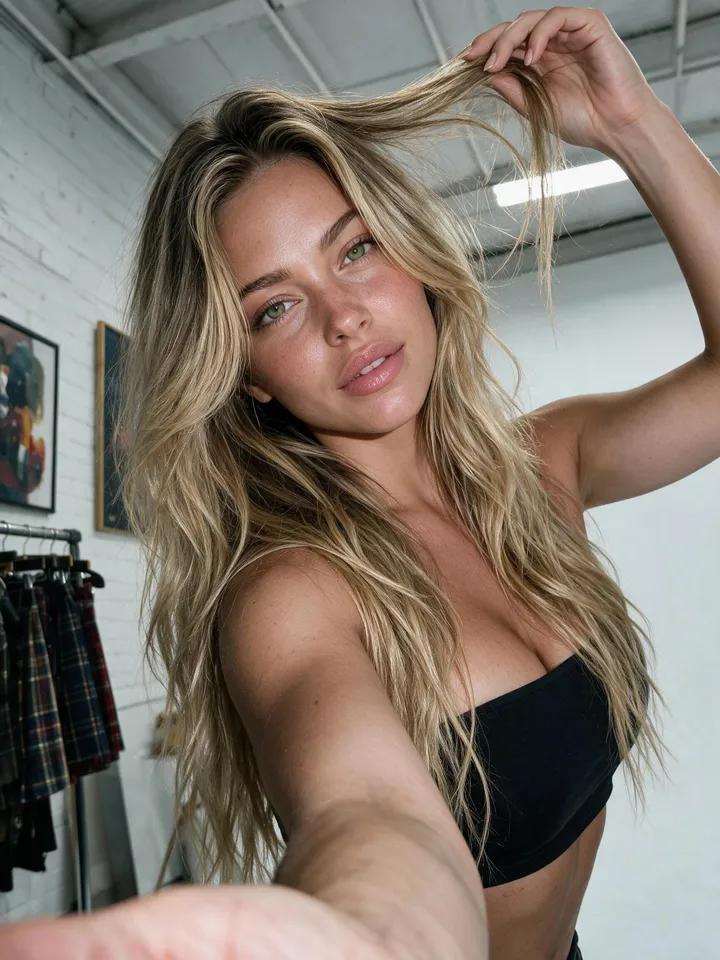
The character stays. On OFMAI you build it once — from 3 of your own reference photos, with no training, or designed from a text description — and that one character is reused in every generation, so the same look, body and morphology carry across photos, short videos and voice. Nothing about the persona has to be rebuilt for a second market, and nothing drifts because a prompt was retyped in another language.
What has to be remade is anything a viewer reads or hears: the spoken track, the captions, any text burnt into the frame, the post copy and the message scripts. That is the whole per-language workload, and it is the reason a persona can carry four markets without four content budgets.
The practical consequence is worth planning around. For a persona that posts stills and short clips, the visual library is one bill and the language count barely touches it; the per-language cost sits almost entirely in audio, text and human review. For long-form video, the ratio flips, because dubbing is priced by the minute and every market pays it again.
Should you dub the clip, or give each language its own voice?
Dubbing keeps one voice identity and works on clips you have already made. It is also the only route that fits a library that is already shot and spoken. The cost is per minute and per market: Rask AI lists Creator at $39 a month for 25 minutes, Creator Pro at $99 for 100 and Business at $249 for 250, with each target language counted separately (official pricing page, read on 19 November 2026). HeyGen prices the same job in credits, from $29 a month for 600 credits on Creator up to $149 a month plus $20 a seat on Business (official pricing page, read on 19 November 2026).
The other route is a voice per market. On OFMAI you can design a voice from a written description for 8 credits — about $1.20 at Agency rates — so four markets is 32 credits, paid once. You can also clone a voice for 10 credits or take one from the catalogue for 5 credits, and each voice is attached to the character and reused in every note you generate in it afterwards.
Which one wins depends on what the voice is doing. If the voice is part of the persona's identity — the thing someone recognises in a paid voice note — keep one clone and dub. If each market is really its own audience with its own idea of how that persona should sound, a designed voice per market avoids the translated-audio tell altogether. Designing a voice is not a substitute for dubbing an existing clip: it produces new audio, it does not re-voice a track you already have.
What does the monthly workflow look like for an agency?
Build the character once, then run a fixed loop. Shoot the master month in one sitting — the stills, the clips and the voice notes for the persona, generated from the stored character so every asset is on-model. Lock a glossary per market before anything is translated: the persona's name, the product names and the phrases that are never translated literally. Write each market's script from the master script rather than from the previous translation, and have a native speaker read it before it is voiced.
Then produce the audio: dub the clips with a translation tool that carries the cloned voice, or generate voice notes in the voice attached to the character. Re-time the on-screen text, because translated lines are usually longer than the source and will crowd a frame that was laid out for the original. Publish per market, and measure per market — watch time and conversion language by language, never in aggregate, or a market that is quietly failing hides behind one that is working.
Two things go wrong at this stage, predictably. The first is skipping the native review pass to save a day; it does not save a day, it moves the cost to the comments. The second is testing all markets at once — start with one piece of content in three priority languages, measure for a fortnight, and only then roll the format out. Keep the ownership obvious too: one person per market who signs off the script and the audio, not a shared queue.
What does a four-language persona cost per month?
Take one persona posting 30 photos, eight five-second 720p clips and 20 short voice notes a month. On OFMAI that is 204 credits, which sits inside the Business plan — 300 credits for $49.99 a month — with room left for re-rolls. The Agency plan is 1000 credits for $149.99, which is sized for a roster rather than one persona: enough for roughly 500 photos, or about 76 five-second 720p clips, in a month. Annual billing takes 25% off, subscription credits renew every month, credits bought as a top-up never expire, and failed generations are refunded automatically.
Going from one market to four does not change that number. The same 30 photos and eight clips serve every market, so the content side is flat. What scales is the localization bill, and for short-form it stays small: eight five-second clips is under a minute of video, so four markets is a few billed minutes a month — inside the 25 minutes of Rask AI's Creator plan at $39 a month (official pricing page, read on 19 November 2026).
Long-form is where the per-language rule bites. By the billing rule Rask states on that same page, a 5-minute master into four languages is 20 billed minutes, so a weekly five-minute video in four markets is 80 minutes a month and needs the 100-minute tier, not the 25-minute one. Budget the dubbing layer from your video length, not from your post count.
The line item agencies underestimate is neither of those: it is a native reviewer per market. One pass over a script and an audio track per market, every month, is a real recurring cost in money or in someone's hours, and it is what separates four markets that work from four markets that look machine-made.
Is dubbed audio worth it, or will subtitles do?
Start with subtitles, because they are cheap and reversible, and they do test the one thing you actually need to know: whether that market wants this persona at all. Language does matter to buying — CSA Research's "Can't Read, Won't Buy" survey of 8,709 consumers in 29 countries, published in 2020, found that 76% of online shoppers prefer to buy a product whose information is in their own language, and that 40% say they will not buy from a site in another language. Read the 76% carefully: it describes a choice between similar products, not a refusal in general.
What you will not find is a credible number for how much dubbed audio beats subtitles. The multipliers quoted in dubbing vendors' own marketing — engagement "3-5x higher", watch time "40-70% longer" — are published without a source or a sample. Treat them as sales claims, not as data you can plan a budget against.
So find out the cheap way. Pick one piece of content, ship it subtitled in three markets, dub the same piece in those three, and compare watch time and conversion per language over a fortnight. The answer differs by market and by format, which is exactly why no vendor's single multiplier can be true everywhere.
When is OFMAI the wrong tool for this?
If what you need localized is an existing library of a real person talking to camera, a dubbing or avatar tool is the whole answer and OFMAI adds nothing to it. Those tools exist to translate footage you already have, and they are better at it than any content studio will be.
If the bottleneck is conversations rather than content, this is also the wrong shelf: OFMAI is not a CRM, a fan-messaging tool or a chat automation, and running four languages of DMs is a staffing and tooling problem it does not touch. Same for distribution — OFMAI is not a scheduler or a publishing hub, so you generate and export, then post where you already publish.
And if what you need is a guarantee that one voice speaks fifty languages, buy that from the dubbing layer and judge it on its own published coverage. OFMAI's job in this stack is the persona: one character that stays the same person everywhere, its photos and clips, and a voice attached to it. The translation is a layer on top, and it is a layer worth paying for separately.
A multilingual AI influencer at a glance
- Built once, not per market — one character reused in every generation, same look, body and morphology
- Per market — the spoken track, the captions, the on-screen text, the post copy and a native review pass
- Photos — from 2 credits each, about $0.30 at Agency rates
- A five-second clip — 7 credits at 480p, 13 at 720p, 25 at 1080p
- Voice — clone 10 credits, design one from a description 8, catalogue voice 5, notes from 2
- One persona, 30 photos + 8 clips + 20 short notes — 204 credits a month, flat whatever the language count
- Plans — $9.99 to $149.99 a month (30 to 1000 credits), 25% off billed annually
- The dubbing layer, bought separately — billed per target language, from $39 a month for 25 minutes on Rask AI (pricing page, read 19 November 2026)
- Not included — translation, subtitle timing, scheduling, publishing or fan messaging
OFMAI in numbers
- creators signed up
- 13,000+
- photos and videos generated
- 72,000+
- videos generated
- 11,000+
Frequently asked questions
How do agencies scale an AI influencer to several languages with one cloned voice?
In two layers. The character and its assets are built once on a content studio like OFMAI — one character reused in every generation, so the look, body and morphology never change — and only the audio and text are produced per market, by a dubbing tool that carries the cloned voice into each target language. The visual bill stays flat as markets are added; the localization bill scales per language.
Can one voice clone actually speak several languages?
Only through a dubbing tool, and the coverage is that tool's. Rask AI's pricing page lists voice cloning in 57 languages and translation in over 135; HeyGen's lists 175+ languages and dialects for video translation (both read on 19 November 2026). The clone itself is one voice identity, re-synthesised per market.
Does the character have to be rebuilt for each market?
No. On OFMAI you build one character — from 3 of your own reference photos with no training, or designed from a text description — and it is reused in every generation, so the same look, body and morphology carry across photos, short videos and voice for every market.
What does each extra language cost?
Almost nothing on the content side and a per-minute fee on the localization side. The same photos and clips serve every market, while dubbing tools count each target language separately: Rask AI states that a 5-minute video into 2 new languages uses 10 minutes, on plans from $39 a month for 25 minutes (pricing page, read on 19 November 2026).
Is it better to dub the clips or design a separate voice per language?
Dub when the voice itself is part of the persona's identity, or when the clips already exist. Design a voice per market when each audience has its own idea of how the persona should sound: a designed voice costs 8 credits on OFMAI, about $1.20 at Agency rates, so four markets is 32 credits paid once.
Which OFMAI plan suits an agency running one persona in four languages?
Business — 300 credits for $49.99 a month — covers roughly 30 photos, eight five-second 720p clips and 20 short voice notes with room to re-roll. Agency is 1000 credits for $149.99 and is sized for a roster of personas rather than one.
Do subtitles work instead of dubbed audio?
Often, as a first test. CSA Research's "Can't Read, Won't Buy" survey of 8,709 consumers in 29 countries, published in 2020, found 76% of online shoppers prefer to buy a product whose information is in their own language — for similar products — and 40% would not buy from a site in another language. The engagement multipliers dubbing vendors quote for audio over subtitles are published without sources, so test one piece of content both ways before budgeting.
Does OFMAI translate scripts or publish the localized versions?
No. OFMAI is a content studio: it builds the character and generates photos, short videos, image edits and voice notes, all in the browser with no GPU. Translation, subtitle timing, scheduling, publishing and fan messaging are separate layers that agencies buy and staff separately.
Related: AI influencer generator · AI voice generator for creators · Clone your voice for paid voice notes · Batch a month of AI content in one sitting · Keep an AI character consistent in video · AI video generator for creators · OFMAI pricing · Talking video in her own cloned voice · Resolutions and aspect ratios by platform · Build characters who look like sisters
OFMAI generates synthetic imagery. Uploading photos or cloning the voice of a real person requires that person's explicit consent, enforced by automated and human moderation. Disclose AI-generated content wherever the platform you publish on or applicable law requires it.