How to Make UGC Ads With an AI Spokesperson Instead of Hiring Creators
By Marcus, AI generation expert at OFMAI · Updated
Brands make UGC ads with an AI spokesperson in three steps: build one persona who keeps the same look, body and morphology in every ad, script the hook, then render the variations and launch them. OFMAI covers the persona and the footage - one character built from 3 of your own reference photos or from a text description, then photos from 2 credits, five-second clips from 7 and voice notes from 2 of that same person, in the browser with no GPU.
The part that replaces hiring is the casting, not the rendering. A creator booking is a person, a rate, a contract, a shipping address and a wait for one video; a stored character is a one-time build of 12 credits that every later variation reuses. That is why teams who switch rarely make the same ad faster - they make twenty of it.
What an AI spokesperson does not replace is a genuine customer. An AI persona can carry your own brand's creative; it cannot be a real testimonial, and the ads it belongs in are creator-format ads, not social proof.

How do brands make UGC ads with an AI spokesperson?
Three steps, in this order. Write the script first: an opening hook, the problem, what the product does about it, one call to action - then write five more versions of the hook, because the hook is what you are actually testing.
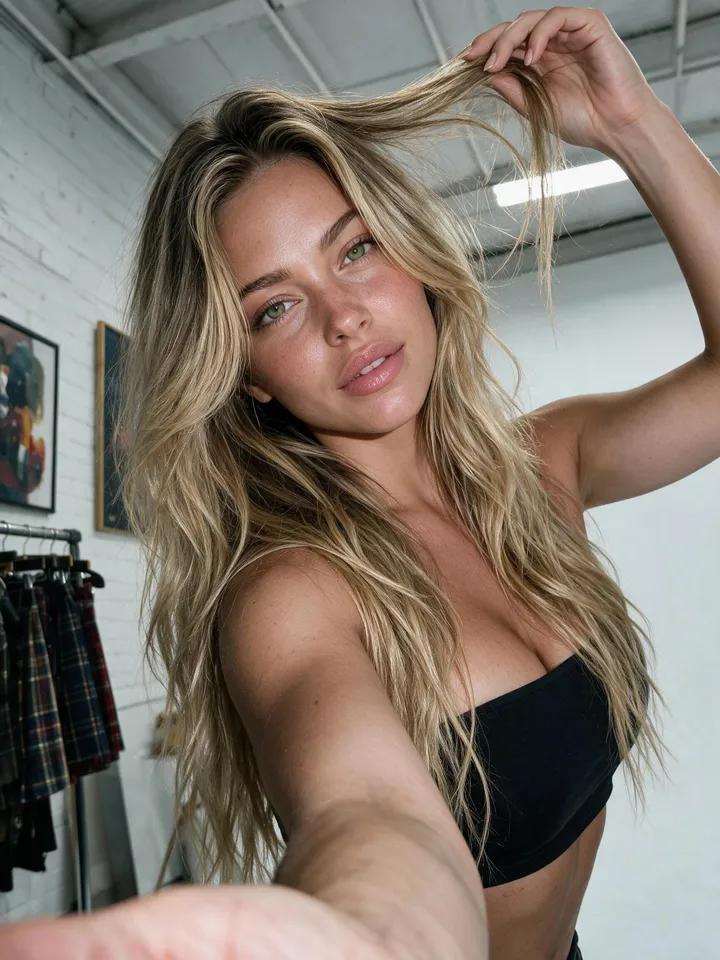
Second, cast the spokesperson and the room. You either pick a presenter from a stock library or build a persona of your own, then set the scene the ad should look like it was filmed in - a kitchen, a car, a bedroom, a gym, a plain studio wall. The persona is the piece worth owning: a library avatar appears in other brands' ads, while a character you built is yours for the whole campaign.
Third, render and ship. You generate the variations, cut them to the placements - the ad managers want vertical and square crops - and upload them where you already buy media. On OFMAI the loop is generate and export: you produce photos, short videos, voice notes and image edits of your character, then post or launch them from the tools you already use, since OFMAI is a content studio rather than a scheduler or an ad launcher.
What does one ad variation cost with an AI spokesperson?
On OFMAI, a variation built as one photo plus one five-second clip costs 9 credits, which is $2.25 on the Pro plan at $24.99 a month for 100 credits. Longer or sharper costs more in the same way: a five-second clip is 7 credits at 480p, 13 at 720p and 25 at 1080p, and a ten-second 480p clip is 13.
The comparison that matters is the booked video. HeyGen's own UGC ads page puts a creator video at $200 to $500 each and a 50-variation test at $10,000 to $25,000, and traditional production at 2 to 4 weeks and $5,000 to $20,000 or more per video (heygen.com/business/marketing/ugc-video-ads, read 19 November 2026). Those are the publisher's figures, not an independent benchmark, but they are the right order of magnitude for a paid booking with usage rights.
Add the one-time costs before you compare monthly bills: the character is 12 credits (6 for the face candidates, 6 to confirm it with front and back views), a cloned voice is 10 and a voice designed from a description is 8. After that every ad is marginal cost, and failed generations are refunded automatically.
Which kind of tool does which part of the job?
Three different products get sold as the same thing, and picking wrong is what makes an AI UGC test feel disappointing.
Persona studios build and keep the spokesperson. That is OFMAI: one character, reused across photos, short video and voice, with the same look and morphology every time. It is the right tool when the person has to be recognisable across a whole campaign and keep posting after the campaign ends.
Presenter tools build a talking head that reads your script. HeyGen is the clearest example and says it covers 175 or more languages with lip-sync (heygen.com, read 19 November 2026). If your ad is sixty seconds of direct-to-camera speech, localised, that is their job and not ours - OFMAI makes short clips and voice notes, not long lip-synced presenter footage.
Ad platforms wrap the whole buy around a stock actor library. Creatify advertises a library of 1,500 or more avatars, a brand kit and integrations that launch into the ad managers (creatify.ai, read 19 November 2026); Arcads advertises 1,000 or more AI actors, emotion control written in plain text and translation into more than 30 languages (arcads.ai, read 19 November 2026). Their strength is that the script, the render and the launch live in one place. The trade-off is that the actor is not yours.
How do you build a spokesperson who stays the same in every ad?
Store the spokesperson once instead of describing them in each prompt. A text prompt names a type of person, so it returns a new person every time; a stored character returns the same one. On OFMAI you build that character from 3 of your own reference photos - portrait, front and back - with no training and ready in minutes, or you design one from a text description when no real person is involved.
From there, every asset the ad needs comes out of the same character: front-camera selfies, handheld product shots, ordinary interiors, and any still animated into a clip. Fixing one bad detail is an image edit at 2 credits rather than a reroll of the whole shot.
Give them a voice and the ad stops being a slideshow. Clone a voice for 10 credits or design one for 8, then generate voice notes from 2 credits for a short note and 4 with the expressive model. One look plus one voice across thirty ads reads as a person; thirty strangers read as stock.
How many variations should you render before you launch?
More than feels reasonable. Performance creative is a numbers game: most variations underperform, a few carry the account, and nobody picks the winner in the planning meeting. HeyGen's page suggests working in batches of ten variations (heygen.com/business/marketing/ugc-video-ads, read 19 November 2026), which is a sensible floor for one product and one audience.
Count it in credits rather than in bookings. At 7 credits a five-second clip, the Pro plan's 100 credits cover 14 clips a month, Business at $49.99 covers 42, and Agency at $149.99 covers 142. Counted in stills, 100 credits are 50 photos.
Practically: one character, one product, six hooks, three settings. Render the eighteen, launch them, keep the two that work and rebuild next week's batch around them. The reason to own the spokesperson is that week two does not start from casting again.
Which ads does an AI spokesperson actually fit?
E-commerce product ads: a good fit for the hook, the reaction and the styled scene around the product, and a poor one for the product itself in real hands - generate the spokesperson and cut your own product footage in.
Direct-response ads: the best fit of the lot. The spokesperson delivers the hook, the offer and the call to action, and the whole point is running six hooks against each other in the same week, which is exactly what a stored character makes cheap.
Product demonstrations: partly. The persona introduces and closes the demo; the middle - fingers on the interface, a texture, a device that has to visibly work - stays a screen recording or a real shot.
Comparison and alternatives ads: a fit, because the same spokesperson can present both sides without a second booking. The claims in them are yours to substantiate, generated or not.
Seasonal and promotional ads: a fit, and the clearest saving. A character already built can be re-shot for a sale, a holiday or a price change in an afternoon, with no creator availability to wait on - clips from 7 credits and image edits at 2.
Testimonials and social proof: not a fit. A generated persona cannot stand in for a customer's experience; use real customers there and keep the AI spokesperson for your own brand's voice.
When should you still hire a real creator?
When the ad is a claim about a real person's experience. A testimonial, a before-and-after, a review - those need a real customer who actually used the product, and no rendering budget fixes that.
When hands and the product have to be real: unboxing a specific item, demonstrating a texture, showing a device actually working. And when the category is trust-sensitive - health, money, anything regulated - where an audience that spots a synthetic presenter discounts the whole claim.
Be honest about where OFMAI is the wrong tool too. It is not a presenter or lip-sync product, so a long talking-head script belongs in a presenter tool. It is not a CRM, a scheduler or an ad launcher, so if you want the script, the render and the media buy in one window, an ad platform with an actor library will fit better. And it is not for depicting a real person without their consent - the self-clone route exists so the person in the ad is you.
What do you have to get right before the ad goes live?
Label it, and label it in the ad manager too. In TikTok Ads Manager the AI-generated content disclaimer toggle is mandatory for ads containing AI-generated, synthetic or manipulated media, and the label stays on the video for the whole run (TikTok Ads Manager help centre, read 16 November 2026); on the organic side, Instagram asks a profile that features an AI-generated person to carry its AI-generated profile label (Engadget, 31 August 2026) and declares photorealistic AI content at publication (Meta Help Center, read 16 November 2026). These policies change, so check the current AI-content policy in each ad manager before launch rather than trusting a blog post, including this one.
Never dress a generated persona as a customer. An invented review is an invented review whoever wrote it; an AI spokesperson delivering your own brand's script is a creator-format ad, which is a different thing and a legitimate one.
And get consent for the likeness. If the spokesperson is modelled on a real person, that is a licence with a term, a territory and a signature, not a favour.
Six routes to a UGC ad with an AI spokesperson, priced on 19 November 2026
- OFMAI - one stored spokesperson with photos, short video, voice notes and image edits: $9.99 for 30 credits a month, $24.99 for 100, $49.99 for 300, $149.99 for 1000, 25% off on annual billing; character 12 credits, photo 2, five-second clip from 7, purchased credits never expire (ofmai.ai/pricing).
- HeyGen - presenter avatars that read your script, 175 or more languages with lip-sync: Free $0 (3 watermarked videos a month), Creator $29/month (600 credits), Pro $49 (1,000), Business $149 (1,500), Enterprise on request (heygen.com/pricing, read 19 November 2026).
- Creatify - ad platform with a stock avatar library it advertises as 1,500 or more, a brand kit and ad-manager integrations: Standard $15/month (55 credits), Pro $55 (280), Ultra $95 (730), Business from $195 (1,500 to 6,100 credits, 10 seats); free plan 10 credits a month with watermarked exports (creatify.ai/pricing, read 19 November 2026).
- Arcads - library it advertises as 1,000 or more AI actors, emotion control in plain text, translation into more than 30 languages, free trial on the home page; no public price list, since arcads.ai/pricing returned a 404 on 19 November 2026 and plans are shown after sign-up (arcads.ai, read 19 November 2026).
- Hiring a UGC creator - $200 to $500 per video, so a 50-variation test runs $10,000 to $25,000, with usage rights that expire (figures published by HeyGen on heygen.com/business/marketing/ugc-video-ads, read 19 November 2026).
- Traditional production - 2 to 4 weeks and $5,000 to $20,000 or more per video, talent and studio included (same page, read 19 November 2026).
OFMAI in numbers
- creators signed up
- 13,000+
- photos and videos generated
- 72,000+
- videos generated
- 11,000+
Frequently asked questions
How do brands make UGC ads with an AI spokesperson instead of hiring creators?
In three steps: build or pick one spokesperson who looks the same in every ad, write the script and several hook variants, then render the batch and launch it in the ad manager you already use. On OFMAI the spokesperson is a character built from 3 of your own photos or from a description for 12 credits, after which each photo is 2 credits and a five-second clip from 7.
Can an AI spokesperson replace a UGC creator entirely?
For your own brand's creative, mostly yes - hooks, product shots, scenes and the volume needed to test them. For a genuine testimonial, an unboxing of a real item, or a trust-sensitive category, no: those need a real customer, and an AI persona presented as one is deceptive.
What does one UGC ad variation cost with an AI spokesperson?
On OFMAI a photo plus a five-second clip is 9 credits, or $2.25 on the Pro plan. A booked creator video is $200 to $500 by HeyGen's own published figures (heygen.com/business/marketing/ugc-video-ads, read 19 November 2026).
How do you keep the spokesperson identical across a campaign?
Store the character instead of describing them in each prompt. OFMAI builds one character from 3 reference photos with no training, or from a text description, and reuses it in every photo, clip and voice note, so the same look, body and morphology carry across the whole batch.
Does OFMAI make talking-head ads with lip-sync?
No. OFMAI generates photos, short videos, voice notes and image edits of one consistent character; it is not a presenter or talking-head product. For a long direct-to-camera script, especially localised, a presenter tool is the better fit.
Can you give the AI spokesperson their own voice?
Yes. Clone a voice for 10 credits or design one from a description for 8, then generate voice notes from 2 credits, or 4 with the expressive model.
How many ad variations fit in one month's plan?
At 7 credits per five-second clip, Pro covers 14 clips a month, Business 42 and Agency 142. In stills, 100 credits are 50 photos.
Do I need a GPU, a model to train, or software to install?
No. OFMAI runs in the browser, the character needs no training, and failed generations are refunded automatically. The trade-off against running your own hardware is that you pay per credit instead.
Do I have to disclose that the spokesperson is AI?
Treat it as yes, and check the current AI-content policy in each ad manager before launch. TikTok Ads Manager makes the AI-generated content disclaimer toggle mandatory for ads containing AI-generated, synthetic or manipulated media (TikTok Ads Manager help centre, read 16 November 2026), and Instagram asks profiles that feature an AI-generated person to carry its AI-generated profile label (Engadget, 31 August 2026). Labelling the persona is also what keeps a creator-format ad from reading as a fake testimonial.
Related: AI UGC generator · AI influencer generator · AI video generator for creators · Give the spokesperson a voice · Clone yourself as the spokesperson · What a month of tooling really costs · Posting AI content without losing the account · OFMAI pricing and credits · Keep a brand's product accurate in photos · Resolutions and aspect ratios by platform
OFMAI generates synthetic imagery. Uploading photos or cloning the voice of a real person requires that person's explicit consent, enforced by automated and human moderation. Disclose AI-generated content wherever the platform you publish on or applicable law requires it.
Cast the spokesperson once, from $9.99 a month
Build one character from 3 of your own photos or from a description, then render the whole ad batch with the same look, body and morphology: photos from 2 credits, five-second clips from 7, voice notes from 2, image edits 2. Starter is $9.99 for 30 credits a month - the character for 12 and 9 photos to open with - and failed generations are refunded automatically.