Can You Promote an AI Model on Instagram and TikTok Without Getting Banned?
By Marcus, AI generation expert at OFMAI · Updated
Yes, on both, provided you say it is AI. Neither platform bans generated people: Instagram asks profiles that feature an AI-generated person to carry its AI-generated profile label, and TikTok's Community Guidelines state that "we require creators to label AI-generated or significantly edited content that shows realistic-looking scenes or people" (TikTok Community Guidelines, Integrity and Authenticity, released 25 August 2026, effective 24 September 2026). What gets an account removed is deception - a persona passing as a real human, another person's likeness used without permission, a claim the product cannot deliver - not the use of AI itself.
OFMAI is the content layer of that setup, not the compliance layer. You build one persistent AI character, from 3 of your own reference photos with no training or from a text description, then generate photos, short videos, voice notes and image edits of that same character with the same look, body and morphology in every output - photos from 2 credits, five-second clips from 7. It is not a scheduler or a publishing hub and it does not apply platform labels for you: you generate, export, then post and declare where you already publish.

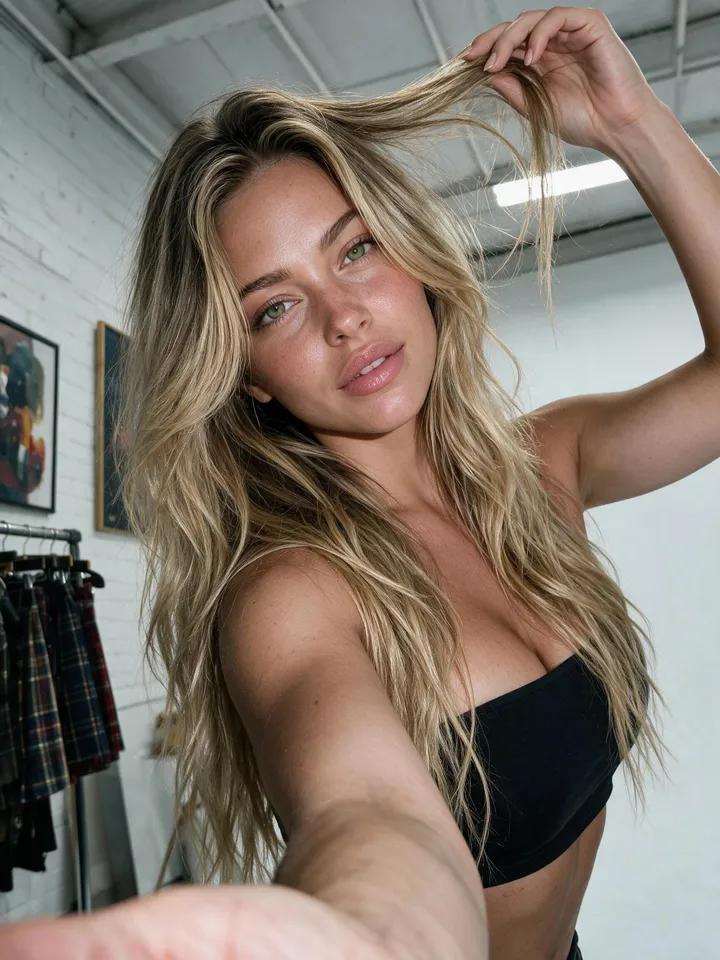
Can you promote an AI model on Instagram and TikTok without getting banned?
Yes. Both platforms allow an AI-generated persona, both ask you to declare it, and in practice the penalty for skipping the declaration is lost reach rather than a ban. Instagram's position, reported by Engadget on 31 August 2026, is that accounts featuring AI humans without the label "may soon see limits to their reach", in the words of an Instagram spokesperson; the account stays up, the creator is notified, and the decision can be appealed through the Account Status dashboard.
TikTok is stricter about the content than about the account. Its Community Guidelines require a label on AI-generated or significantly edited content that shows realistic-looking scenes or people, and say TikTok may remove, restrict or label unlabelled content itself, depending on the harm it could cause (TikTok Community Guidelines, released 25 August 2026). A permanent ban sits at the severe end of an escalating ladder, not at the first unlabelled clip - but the ladder does end there, so the label is cheap insurance.
What does Instagram require for an AI-generated persona?
One label on the profile, plus a declaration on photorealistic posts. Instagram replaced its optional "AI creator" label with an "AI-generated profile" label aimed specifically at profiles that feature an AI-generated person, set in profile settings and shown on the profile and next to the account name on posts and Reels (Engadget, 31 August 2026; Lindsey Gamble, creator-economy analyst, September 2026). A profile that should carry it and does not can lose eligibility for recommendations, which is where most of a young account's reach comes from.
On the content side, Meta's help centre says it labels posts when it detects industry-standard AI signals in the file or when the person posting declares it, and that some AI-generated content carries no detectable signal at all - which is exactly why the self-declaration control exists (Meta Help Center, "How to identify AI content on Meta products", read 16 November 2026). Declaring is the default worth adopting: it is a labelling requirement, not a distribution penalty, and an audience that finds out later tends to leave in one move rather than gradually.
What does TikTok require?
A label on any realistic AI content, applied by you or applied for you. The disclosure methods TikTok lists in its own AI-generated content policy are an on-screen note, a watermark, a note in the description, or the "AI-generated content" toggle at the moment of posting; TikTok's official AI effects are labelled automatically, a label the platform has applied cannot be removed, and labelling content falsely is a violation in its own right (TikTok Shop Academy, AI-Generated Content policy, last updated 9 February 2026).
Labelling does not make everything permitted. The same guidelines keep two categories off the platform even when the content is labelled: content misleading about matters of public importance, and content harmful to an individual (TikTok Community Guidelines, released 25 August 2026). A correctly labelled AI persona making a false claim about a product is still a violation - the label answers "is this real?", not "is this honest?".
What actually gets an AI model account banned?
Deception, and other people's identities. The prohibited practices in TikTok's AI-generated content policy map closely onto how AI personas get into trouble: misleading or false claims about a product, unauthorised use of someone's likeness, voice, name or trademarks, impersonating a professional such as a doctor to promote health products, exaggerated effects such as instant or unrealistic results, fear-based or shocking AI visuals, and altering a product's appearance, size, quantity or features so it does not match what the buyer receives (TikTok Shop Academy, AI-Generated Content policy, last updated 9 February 2026).
The sanctions escalate rather than arriving all at once. That policy describes warnings, content removal or restricted visibility, removed product links, Creator Health Rating deductions, account restrictions, and permanent bans reserved for severe cases. Two of those prohibitions deserve a second read if your character is based on a real person: build it from photos of yourself, or from a model who has signed a licence covering AI use, and never from a stranger's pictures. That is the one mistake on this list with legal consequences beyond the account.
Do the rules change when you pay to promote?
Yes - a toggle that is optional organically becomes mandatory in ads. In TikTok Ads Manager, the ad-disclaimer toggle for AI-generated content is required for ads containing AI-generated, synthetic or manipulated media, including real footage significantly altered by AI; the disclaimer sits at the bottom of the video for the ad's entire run and works with Spark Ads as well as ordinary in-feed ads (TikTok Ads Manager help centre, "About ad disclaimers", read 16 November 2026).
Paid promotion also stacks two separate disclosures. One says the content is AI; the other says the post is an ad or a paid partnership. A sponsored post from a realistic AI persona generally needs both, because a platform's AI label is not an advertising disclosure and does not stand in for one. Check each platform's current ads policy before a campaign rather than from memory: these rules moved on every surface named on this page during 2026.
Does a consistent AI character make the label more necessary?
Yes, and that is precisely what it is for. A persona that holds the same look, body and morphology across hundreds of photos and clips is what makes an account worth following, and it is also what reads as a real human to a stranger scrolling past. An Instagram spokesperson told Engadget on 31 August 2026 that the community "don't like coming across a profile that seems human". Consistency is not the problem; undeclared consistency is.
In practice the two goals sit together with no tension at all. Keep the character consistent, keep the bio honest, set the profile label once and leave the per-post control on. On OFMAI, a character built from 3 reference photos or from a description is reused in every generation - photos at 2 credits, image edits at 2, five-second clips from 7 to 25 credits depending on resolution, a cloned voice at 10 and voice notes from 2. Plans start at $9.99 a month for 30 credits and run to $24.99 for 100 - roughly $0.67 a photo on Starter. Failed generations are refunded automatically.
When is OFMAI not the right tool for this job?
When what you actually need is distribution or compliance rather than content. OFMAI does not post for you, does not set an Instagram profile label and does not flip a TikTok toggle; it is not a scheduler, not a publishing hub, and not a CRM or messaging tool. If your bottleneck is posting cadence, approvals or coordination across several accounts, a scheduling tool is the purchase to make, and a generator will not fix it.
Two other honest limits. If you want a presenter talking to camera about a product, avatar and talking-head tools are built for that and will get you there faster. If you want to own the model weights and run on your own hardware, a local open-source setup gives you control a hosted studio cannot, at the cost of a GPU, the setup and the training time. OFMAI's case is narrower on purpose: one recurring character, generated in the browser with no GPU, with photos, short video and voice in the same place.
The disclosure checklist, surface by surface
- Instagram profile: set the AI-generated profile label in profile settings if the account features an AI-generated person. It shows on the profile and beside your name on posts and Reels (Engadget, 31 August 2026).
- Instagram posts: declare photorealistic AI content when you publish. Meta also detects standard AI signals in the file, but some generated files carry none (Meta Help Center, read 16 November 2026).
- TikTok posts: switch on the AI-generated content toggle, or add an on-screen note, a watermark or a line in the description (TikTok Shop Academy AI-Generated Content policy, 9 February 2026).
- TikTok ads: the AI-generated content disclaimer toggle is mandatory for generated, synthetic or manipulated media (TikTok Ads Manager help centre, read 16 November 2026).
- Any paid post: add the ad or paid-partnership disclosure as well. An AI label is not an advertising disclosure.
- Never label falsely and never try to strip a label the platform applied - each is a violation on its own (TikTok Shop Academy, 9 February 2026).
- Never use a real person's likeness, voice, name or trademarks without permission. Build the character from your own photos, or from a model who signed a licence covering AI content.
- Never claim a result the product cannot deliver: exaggerated or instant effects are prohibited whether or not the content carries a label.
OFMAI in numbers
- creators signed up
- 13,000+
- photos and videos generated
- 72,000+
- videos generated
- 11,000+
Frequently asked questions
Can I promote an AI model on Instagram and TikTok without getting banned?
Yes, as long as you disclose it. Both platforms allow AI-generated personas and both require a label: Instagram an AI-generated profile label on accounts that feature an AI-generated person, TikTok a label on AI-generated or significantly edited content showing realistic-looking scenes or people (TikTok Community Guidelines, released 25 August 2026). The usual consequence of skipping it is reduced reach or a removed post, with permanent bans reserved for severe or repeated cases - typically deception, a real person's likeness used without permission, or false product claims.
Do I have to tell people my influencer is AI?
On both platforms, yes, in the places they provide. Instagram asks profiles featuring an AI-generated person to carry its AI-generated profile label, and TikTok requires creators to label realistic AI content when posting. Neither asks you to write it in every caption, and the label is a disclosure requirement rather than a penalty - Instagram's own reasoning, reported by Engadget on 31 August 2026, is that people dislike finding out afterwards that a profile that seemed human was not.
What happens on Instagram if I don't use the AI-generated profile label?
Your reach gets limited rather than your account removed. An Instagram spokesperson told Engadget on 31 August 2026 that accounts with AI humans not using the label "may soon see limits to their reach"; reporting in September 2026 described that as losing eligibility for recommendations. Affected creators are notified, can check Account Status to see whether they are still recommendable, and can either add the label or appeal if Instagram has misidentified the account.
How do I label AI content on TikTok?
Four ways, per TikTok's own AI-generated content policy (TikTok Shop Academy, last updated 9 February 2026): switch on the AI-generated content toggle when you post, add an on-screen note, add a watermark, or put a note in the description. Content made with TikTok's official AI effects is labelled automatically. A label TikTok applies cannot be removed by you, and labelling content falsely counts as a violation by itself.
Can an AI persona run paid ads?
Yes, with an extra disclosure. In TikTok Ads Manager the AI-generated content disclaimer toggle is mandatory for ads containing AI-generated, synthetic or manipulated media, including real footage significantly altered by AI, and the label stays at the bottom of the video for the whole run (TikTok Ads Manager help centre, read 16 November 2026). Paid posts also need the ad or paid-partnership disclosure on top of the AI label - the two are separate requirements.
Does using an AI content generator get my account flagged by itself?
No. TikTok's policy states plainly that using AI is not in itself grounds for a penalty and lists permitted uses including visual effects, editing, translation, subtitles and copywriting (TikTok Shop Academy, 9 February 2026). What is penalised is undisclosed realistic AI content and misleading content. Meta's labelling works the same way: it detects standard AI signals in a file and labels the post, which is a label rather than a strike (Meta Help Center, read 16 November 2026).
Can I build the AI character from photos of a real model?
Only with her written permission. Unauthorised use of a person's likeness, voice, name or trademarks is explicitly prohibited (TikTok Shop Academy, 9 February 2026), and it carries consequences beyond the platform. OFMAI builds a character from 3 reference photos, so the safe routes are your own photos or a model who has signed a licence covering AI-generated content; depicting a real person without their consent is not a permitted use of the product.
Does OFMAI post the content or apply the labels for me?
No. OFMAI generates photos, short videos, voice notes and image edits of one consistent character - photos from 2 credits, five-second clips from 7 credits, a cloned voice at 10, plans from $9.99 a month. It is not a scheduler or a publishing hub, so you export what you generate and post it where you already publish, setting the profile label and the per-post AI control yourself on each platform.
Related: AI influencer generator · AI model generator · Running an AI influencer on Instagram · Where to post AI influencer content · The contract you need before selling AI content of a real model · OFMAI pricing and credits
OFMAI generates synthetic imagery. Uploading photos or cloning the voice of a real person requires that person's explicit consent, enforced by automated and human moderation. Disclose AI-generated content wherever the platform you publish on or applicable law requires it.
Build the character, label the account, post the month
One persistent AI character from 3 of your own photos or from a description, then photos from 2 credits, five-second clips from 7, image edits at 2 and voice notes from 2 - the same look, body and morphology every time. Plans from $9.99 a month for 30 credits. The label on your profile stays your job, and it takes one tap.