
How to Find Content Worth Recreating
By the OFMAI Team · Updated October 2026
Every creator who has tried to reverse-engineer a viral post has made the same mistake: they open a big account, find the post with the highest numbers, and rebuild it. Then it does nothing. The post did not travel because of what was in it. It travelled because two million people were already subscribed to the person who posted it.
The skill in this lesson is separating those two causes. There is one heuristic that does it reliably, it takes about ten seconds per account once you know it, and almost nobody applies it consistently. Everything else in this module — the actual production work — depends on getting this step right. Recreating a well-chosen post badly still beats recreating a badly-chosen post perfectly.
Why follower count contaminates every number you see
Short-form feeds distribute in stages. A new post is shown first to a slice of the account's existing audience. If that slice watches it through, replays it, or comments, the platform widens the test to people who do not follow the account. That second stage is where reach actually comes from — and the first stage is where follower count quietly does its work.
This means a post's raw view count is a mixture of two independent inputs: how good the post is, and how many people were guaranteed to see it regardless. An account with 800,000 followers will put half a million views on a post that is merely fine. An account with 4,000 followers needs a genuinely strong post to reach the same number — and if it does, that post crossed into non-follower distribution repeatedly.
So when you sort a large account by views and take the top result, you are usually selecting for the account, not for the post. You copy the format, publish it to your own small audience, and get the performance that format actually deserves on its own merits, which may be very little. The post was never the reason.
The neighbour test: compare a post to its own account
The fix is to stop comparing posts across accounts and start comparing a post to the posts sitting next to it. The question is not "did this get a lot of views" but "did this get far more views than the same account's other posts from the same period."
That single change cancels out follower count, because both the post and its neighbours were published to the same audience, by the same person, with the same posting history behind them. Whatever is different about the outlier is the post itself — the hook, the concept, the shot, the transition, the question it asked. That is the thing worth rebuilding.
The source material this lesson draws on demonstrates it exactly this way. The instructor lands on an account, notices one reel with roughly ten million views, and points out that the posts around it are not performing — then concludes that the format is what carried it, and that recreating that format with his own character should carry his post too. He also notes that his own experiment with the format did perform well afterwards. That single observation is worth more than every generic list of "viral hooks" on the internet, because it is a repeatable test rather than a claim.
A useful working threshold: an outlier worth your time is doing at least five times the account's typical recent post. Ten times or more is a strong signal. Two times is noise — posts vary that much for reasons nobody can control. Look at six to ten recent posts to establish the baseline, ignore anything older than a few months (formats decay), and skip posts that are obviously boosted by something external such as a collaboration with a much larger account, since that reintroduces exactly the contamination you are trying to remove.
What you are actually extracting
Once you have your outlier, name what travelled — in one sentence, out loud. Vagueness here is what produces useless recreations. "It was a good video" is not an answer. "She does a slow reveal, the effect lands on the beat, and the last two seconds pose a question" is.
In practice the transferable element is almost always one of a small number of things: a visual gimmick that resolves in the first two seconds; a transition or effect that makes the viewer replay it; a question or prompt in the caption or on screen that makes commenting the obvious response; a shot type or setting the platform's audience has not seen much of yet; or a piece of audio being used in a specific way. Any of those can be rebuilt with a different person in frame.
What does not transfer is anything specific to that creator — an established running joke, an audience that already knows their story, an appearance in something else. If your one-sentence description contains the original creator's name or history, the post is not a format. It is theirs. Move on and find another outlier.
Write the sentence down before you produce anything. It becomes the brief for the next lesson, and it is also what you check the finished result against.
Making this a comparison rather than a guess
The neighbour test is easy to describe and tedious to do by hand. You open a profile, tap into a post, note the number, back out, tap the next one, note that number, and by the sixth post you have lost track of the baseline. Most people do two or three and then start guessing.
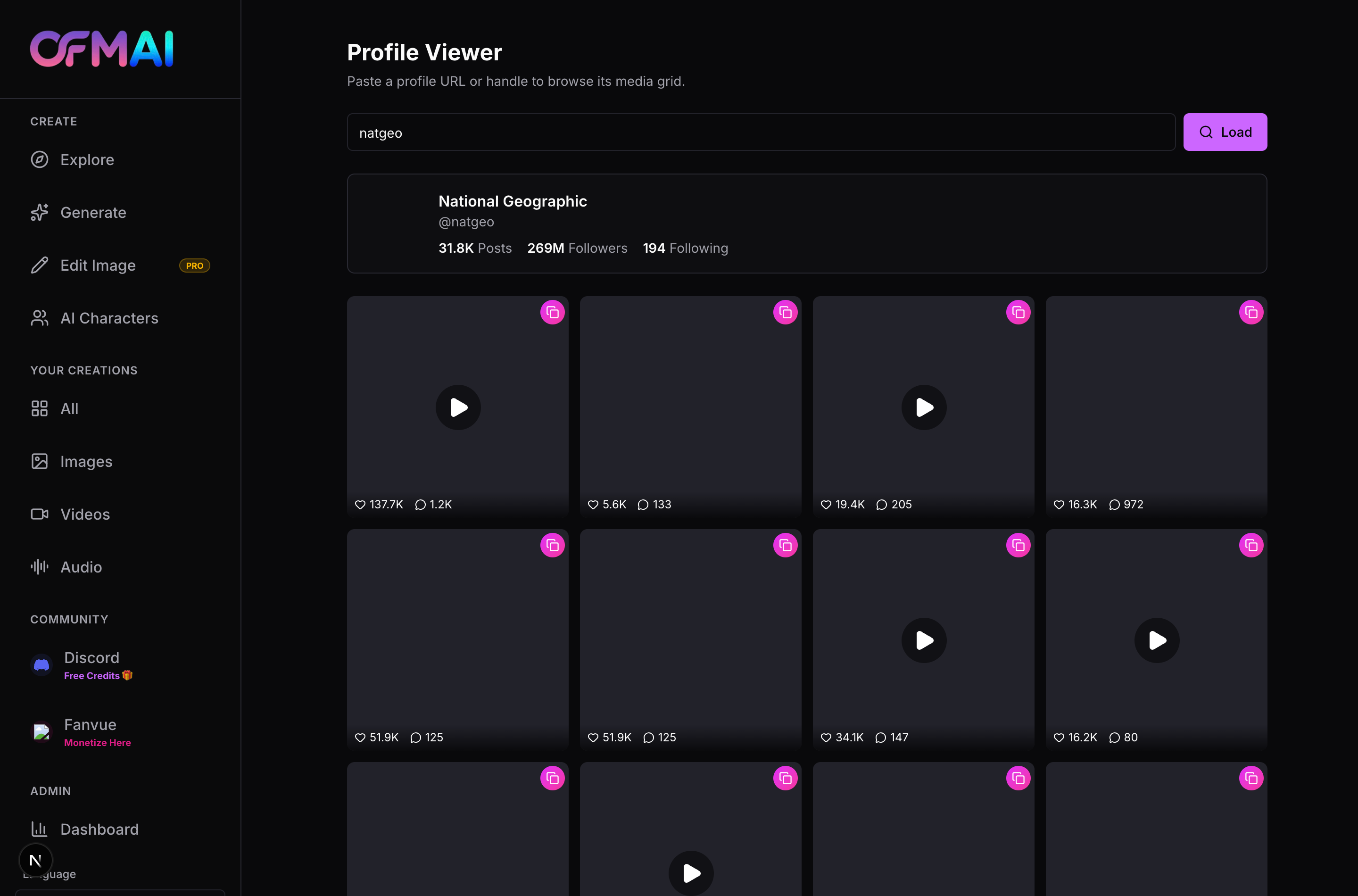
OFMAI's replication browser removes that friction. You paste a public profile's address, and the account's posts load into one grid with their engagement counts printed directly on each thumbnail — likes and comments on every post, plus view counts on videos. The baseline and the outlier are on screen simultaneously. The neighbour test stops being a research task and becomes a visual scan: you are looking for the tile whose number does not match the tiles around it.
The page also shows the profile's follower count in the header, which is worth glancing at for a different reason. It tells you what "normal" means for this account before you judge any individual post, and it stops you mistaking a large account's floor for a small account's ceiling.
Load more posts until you have a real sample rather than the most recent handful — one screenful is not a baseline. Then pick your outlier and read on: the next lesson rebuilds it with your own character, from the same page, without downloading anything.
Building a habit instead of doing it once
One good find will not change your account. A steady supply of them will, and the only way to get a steady supply is to make this a routine rather than an occasional burst of research.
Keep a simple running list — a spreadsheet is enough. One row per outlier: the link, the account's typical numbers, the outlier's numbers, your one-sentence description of what travelled, and whether you have produced it yet. The source material recommends analysing one post per day, and that cadence is about right: it is small enough to actually sustain and large enough that after a month you have thirty formats and, more importantly, a trained eye.
The compounding benefit is not the list. It is that after a few weeks you start recognising the shape of an outlier before you check the numbers, and you start noticing when a format is spreading — the same concept appearing on three unrelated accounts within a fortnight is a trend in progress, and getting in early is worth far more than getting in perfectly.
One caution the source material is honest about: do not publish endless near-identical variations of the same post back to back. Space your formats out, and let each one have its own run. Reach for a new outlier rather than squeezing a fourth version out of a tired one.
Run the neighbour test on an account
Roughly two minutes per account once you are used to it. Repeat on a handful of accounts in your niche.
- Open the replication browser — Go to ofmai.ai/replicate while signed in. The page is not in the sidebar — type the address directly or bookmark it.
- Load a public profile — Paste the profile's address into the field and load it. The posts appear as a grid with likes, comments and — on videos — view counts printed on each tile.
- Establish the baseline — Load more posts until you have a decent sample, then read across the grid for the typical number. Do not average it precisely; you only need the rough level the account normally sits at.
- Find the tile that breaks the pattern — Look for a post doing at least five times the baseline. If nothing does, the account has no outlier right now — move to another account rather than settling.
- Rule out contamination — Open the outlier. If it is carried by a collaboration with a much larger account or by something specific to this creator's history, discard it. You want a format, not a moment.
- Write the one-sentence brief — Describe what travelled in a single sentence with no proper nouns in it. That sentence is your production brief and your quality check.
- Log it — Add the link, the baseline, the outlier's numbers and your sentence to a running list. Aim for one entry a day.
Frequently asked questions
- Is recreating someone else's post ethical?
- What this lesson teaches is recreating a format or concept with your own character, your own shots and your own audio — not republishing anyone's footage. That distinction matters and it is worth being clear about. Copying the idea of a slow reveal, a transition, or a question posed to camera is how every platform has always worked; trends exist precisely because formats get picked up and reinterpreted, and the creator you learned it from almost certainly learned it from someone else. Reposting the original file, or presenting someone else's work as yours, is a different thing entirely and is not what any of this describes. The practical line is simple: if your finished post would be recognisable as a distinct piece of work sitting next to the original, you are participating in a trend. If it would be mistaken for the original, you have gone too far.
- How many followers should the account I study have?
- It matters less than you would think, because the neighbour test already cancels follower count out. That said, mid-sized accounts tend to be the most useful hunting ground. Very large accounts push so much through their existing audience that the difference between a good post and an average one gets compressed, making outliers harder to spot. Very small accounts are noisy in the other direction — a single post can do fifty times the baseline for reasons that have nothing to do with the format, such as being shared once by someone with reach. Accounts somewhere in the tens of thousands to low hundreds of thousands usually give the cleanest reading: enough consistent distribution to establish a real baseline, not so much that everything performs. Study several accounts rather than mining one, and prefer accounts whose style is close enough to yours that the format will actually suit your character.
- What if a post is an outlier because of the audio, not the visuals?
- That is a legitimate finding and often a very good one, but it changes what you should recreate. If a specific piece of audio is doing the work, the transferable element is the audio and the way it is used — the timing of the cut against it, where the beat lands, what happens in the frame at that moment — not the visual concept, which may be interchangeable. Audio-driven trends also move much faster than visual ones, so they reward speed heavily; a format that is two weeks old is usually finished. Check whether the same audio is appearing across several accounts, which confirms it is the driver rather than a coincidence. And be aware you may not be able to use the exact same track, in which case the timing and structure are still worth copying even with different audio underneath.
- How recent does the outlier need to be?
- Recent enough that the format has not saturated, which in practice means weeks rather than months. Short-form formats decay quickly: the same concept that reached millions in its second week reaches very little in its tenth, because the audience has seen it enough times to stop watching. When you establish an account's baseline, use posts from the same period as the outlier rather than the account's all-time history, since accounts grow and an old post's numbers were set against a smaller audience. If your best find is several months old, treat it as an education in what works rather than as a production brief — study why it travelled, then look for the current equivalent. The exception is genuinely evergreen structures, like posing a direct question to camera, which keep working long after any specific execution of them has worn out.
Related reading
Found your outlier? Rebuild it next.
The replication browser you used to find the post is also where you recreate it with your own character. Continue to the production walkthrough.
Start free